
How does Xero reach buyers through advisers and apps?
Xero depends on trust-led channels. In 2025, adviser referrals, direct digital sign-up, and app integrations still shape adoption for small firms that need low-risk switching and fast setup.
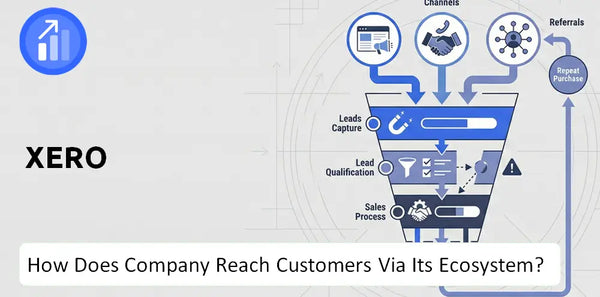
That mix gives Xero leverage across the buying path. A strong partner base can turn product credibility into lower acquisition cost and steadier subscription growth. Read the Xero Value Chain Analysis for the channel view.
Who Does Xero Sell To and Through Which Channels?
Xero sells to small and medium-sized businesses, but the deal is often shaped by accountants and advisers. Its sales run through self-serve subscriptions, partner referrals, and connected software channels, which is why Xero ecosystem competition and route to market matters for demand.

Xero's main route to market
Xero's route to market is a mix of direct digital sales and adviser-led distribution. That blend is central to how Xero turns trust into sales and how Xero demand generation works in practice.
- Small business owners buy the software
- Self-serve web subscriptions drive access
- Accountants control key recommendations
- Adviser trust lowers buying friction
Who Xero sells to
Xero sells mainly to small and medium-sized businesses that need cloud accounting for invoicing, bank feeds, payroll, and reporting. The buyer is often an owner, finance lead, or office manager, but the adviser is often the person who shapes the final choice. That is why Xero customer trust and Xero brand reputation in accounting software matter so much.
How Xero reaches those buyers
The first channel is direct digital sales, where businesses find Xero, sign up online, and start a subscription. The second is accountant and adviser referrals, which are central to how Xero builds brand trust and how Xero converts trust into revenue. The third is ecosystem distribution through app partners, which helps Xero drive product demand around the accounting core.
Why the channel mix works
This is a hybrid sales model, not a pure direct one. Direct acquisition captures buyers already searching for cloud accounting, while the partner route captures trust at the point of advice. That alignment is a core part of Xero marketing and sales alignment and a major driver of Xero sales growth.
What the numbers say
In FY2025, Xero reported revenue of NZ$2.0 billion and subscriber growth above 4 million subscribers. Those figures matter because they show scale in a market where recurring subscriptions depend on both product pull and adviser endorsement. Strong Xero software brand trust helps keep that funnel efficient.
Where trust turns into demand
Xero's demand generation strategy works best when an adviser already trusts the product and the customer only needs a short path to sign-up. That is the key to Xero sales funnel strategy: low-friction direct purchase backed by professional approval. It also supports Xero brand trust and customer loyalty over time.
- Owners want simple setup
- Finance leads want reliable reporting
- Advisers want client-ready tools
- Partners expand reach at scale
Xero SWOT Analysis
- Organized to Save Time on Analysis
- Fully Customizable
- Editable in Excel & Word
- Professional Formatting
- Investor-Ready Format

How Does Xero Reach the Market Through Partners, Platforms, or Distribution?
Xero reaches buyers mainly through accountants, bookkeepers, and advisors who shape software choice and setup. Its cloud platform also spreads through online discovery and app links, so Xero brand trust turns into Xero demand generation inside the workflow people already use.
 Advisers are the strongest access point
Xero sales growth depends heavily on adviser endorsement because these professionals often guide selection, migration, and day-to-day use. That makes Xero customer trust easier to earn, since why customers trust Xero often starts with a known adviser rather than a cold ad.
In practice, this is a high-value channel: 4 main roles shape adoption, accountants, bookkeepers, advisors, and implementation partners. That is why how Xero builds brand trust is tightly tied to Xero marketing and sales alignment.
The main route-to-market dependency is workflow fit
Xero converts trust into revenue when it sits inside payroll, invoicing, expense, and reporting workflows, not when it acts like a stand-alone tool. That is the core of the Xero sales funnel strategy and the reason Xero brand reputation in accounting software matters so much.
The wider ecosystem also expands reach through software connectivity and partner distribution, which supports Xero lead generation tactics and Xero customer retention strategy. For a deeper view of the company's market path, see Industry History of Xero Company.
When the product is embedded across finance tasks, Xero software brand trust becomes a daily habit, and that helps how Xero drives product demand. In this model, Xero business growth strategy depends less on a single sale and more on repeated use across the customer stack.
Xero Value Chain Analysis
- Structured to Support Better Decisions
- Effortlessly Communicate Your Business Strategy
- Investor-Ready Format
- 100% Editable and Customizable
- Clear and Structured Layout

How Does Xero Convert Ecosystem Access Into Revenue?
Xero converts ecosystem access into revenue by turning accountant and advisor trust into paid subscriptions, then expanding usage as the ledger becomes part of daily work. In FY2025, Xero reported revenue of NZ$2.04 billion and subscribers above 4.59 million, showing how Xero brand trust and partner-led demand support conversion, retention, and Demand Ecosystem of Xero Company.
| Access Channel | How It Converts to Revenue | Why It Matters |
|---|---|---|
| Accountant and advisor referrals | Trusted advisers lower sales friction, speed signup, and help more SMBs adopt paid plans. | It strengthens Xero demand generation because trust arrives before the pitch. |
| Workflow embedding | Once used for invoicing, bank reconciliation, and reporting, the product becomes a daily system and supports recurring fees. | It raises renewal odds and improves Xero customer retention strategy because switching costs rise. |
| Multi-client partner standardization | Advisers who roll out Xero across many clients reduce education costs and lift account expansion over time. | It improves monetization efficiency and supports Xero sales growth through repeatable adoption. |
The most economically important route is accountant and advisor standardization, because it combines low-cost acquisition, faster conversion, and stronger retention across many SMB accounts. That is the core of how Xero turns trust into sales: the adviser shapes why customers trust Xero, the workflow locks in use, and recurring billing captures value. In FY2025, the scale effect was visible in 4.59 million subscribers, which shows how Xero brand reputation in accounting software feeds Xero demand generation strategy and Xero marketing and sales alignment.
Xero Business Model Canvas
- Clean, Modern, and Easy to Present
- No Research Needed – Save Hours of Work
- Built by Experts, Trusted by Consultants
- Instant Download, Ready to Use
- 100% Editable, Fully Customizable

What Shapes Xero's Route-to-Market Outlook?
Xero's route-to-market outlook is strongest when cloud use among small and medium-sized businesses keeps rising, accountants keep steering clients to modern tools, and the product stays broad without getting hard to use. In FY25, Xero reported 4.4 million subscribers, showing how Xero brand trust can convert into access when partner relevance stays high and the funnel keeps working.
Strongest access advantage: accountant-led reach
Xero sales growth is most durable when accountants keep recommending it, because adviser referrals lower friction and speed up conversion. That is the core of how Xero builds brand trust and how Xero turns trust into sales across the Xero sales funnel strategy.
Its broad cloud accounting fit also helps. When the product covers invoicing, bank feeds, payroll, and reporting without feeling heavy, Xero demand generation gets a cleaner path from trust to paid use. See also Ecosystem Ownership of Xero Company
Key future access risk: adviser mindshare loss
The biggest threat is channel dependence. If accountants or bookkeepers shift to rivals, Xero customer trust can stay intact but buyer access still narrows fast.
That is the main warning for Xero brand reputation in accounting software. Weaker referral power would hit Xero customer acquisition strategy, slow Xero lead generation tactics, and reduce how Xero converts trust into revenue.
Competitive pressure matters because this market is adviser led, not just brand led. Xero marketing strategy works best when Xero marketing and sales alignment supports partner proof, simple onboarding, and quick first value, since why customers trust Xero usually comes down to ease, reliability, and fit.
For Xero demand generation strategy, the key signal is whether partners keep sending qualified buyers and whether those buyers convert to subscriptions at a steady pace. That also shapes Xero customer retention strategy, because product trust and workflow fit reinforce Xero brand trust and customer loyalty only when the software keeps solving daily finance tasks well.
Xero VRIO Analysis
- Designed for Fast Business Analysis
- Structured for Consultants, Students, and Founders
- 100% Editable in Microsoft Word & Excel
- Instant Digital Download – Use Immediately
- Compatible with Mac & PC – Fully Unlocked

Related Blogs
- Who Connects Most Strongly With the Brand of Xero Company?
- How Strong Is Xero Company's Brand Position Against Competitors?
- How Could Ecosystem Shifts Change the Growth Outlook of Xero Company?
- Who Owns Xero Company and How Does Ownership Affect Trust in the Brand?
- What Do the Mission, Vision, and Values of Xero Company Say About Its Brand Purpose?
- How Did Xero Company Build the Brand It Has Today?
- How Does Xero Company Work and Support Its Brand Promise?
Frequently Asked Questions
Xero turns accountant trust into demand by making advisers a recommendation engine for SMB software choice. The platform covers four core jobs in the finance workflow: invoicing, bank reconciliation, expense tracking, and payroll. When an accountant endorses one system, that trust can influence multiple client accounts, reduce onboarding friction, and shorten the path to a subscription.
Disclaimer
All information, articles, and product details provided on this website are for general informational and educational purposes only. We do not claim any ownership over, nor do we intend to infringe upon, any trademarks, copyrights, logos, brand names, or other intellectual property mentioned or depicted on this site. Such intellectual property remains the property of its respective owners, and any references here are made solely for identification or informational purposes, without implying any affiliation, endorsement, or partnership.
We make no representations or warranties, express or implied, regarding the accuracy, completeness, or suitability of any content or products presented. Nothing on this website should be construed as legal, tax, investment, financial, medical, or other professional advice. In addition, no part of this site - including articles or product references - constitutes a solicitation, recommendation, endorsement, advertisement, or offer to buy or sell any securities, franchises, or other financial instruments, particularly in jurisdictions where such activity would be unlawful.
All content is of a general nature and may not address the specific circumstances of any individual or entity. It is not a substitute for professional advice or services. Any actions you take based on the information provided here are strictly at your own risk. You accept full responsibility for any decisions or outcomes arising from your use of this website and agree to release us from any liability in connection with your use of, or reliance upon, the content or products found herein.