
How does Truist Financial Corporation reach buyers through its channel network?
Truist Financial Corporation sells trust through branches, bankers, digital banking, and specialist teams. That matters because deposits, loans, and wealth fees depend on repeat access, not one-off ads. See Truist Financial Value Chain Analysis for the links between channel reach and revenue.
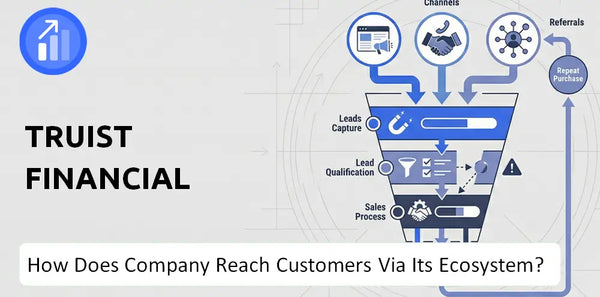
Its edge is cross-sell: one client can move from retail accounts to lending, treasury, and advice. That turns brand familiarity into more products per relationship and higher lifetime value.
Who Does Truist Financial Sell To and Through Which Channels?
Truist Financial sells to households, small and middle-market businesses, and large corporate clients. It reaches them through digital banking, branches, bankers, advisors, and treasury teams, so Truist brand trust turns into sales through both access and advice.

Truist Financial's main route to market
For most customers, Truist Financial uses a digital-first retail model with branch backup. For business and wealth clients, the route shifts to banker-led coverage and direct advice, which is central to the demand ecosystem of Truist Financial Company.
- Households seek deposits, cards, and loans
- Digital banking plus branches drive access
- Relationship teams control business and wealth access
- This route lifts Truist customer acquisition and retention
Who Truist Financial sells to
Truist Financial's core buyers are individuals, small businesses, middle-market firms, and large corporates. Affluent clients also matter because wealth management, insurance, and investment banking widen Truist financial services demand and deepen wallet share.
These groups do not buy the same way. Households value ease and speed, small firms want credit and service, and larger clients want coordinated lending, cash management, and capital markets support.
Channels that shape demand
Retail demand flows through mobile, online banking, call centers, and branches. That mix supports Truist consumer trust because clients can start digital and finish with a person when the need gets more complex.
Business demand is more relationship driven. Commercial bankers, treasury specialists, and relationship managers own the front door, while wealth advisors and investment bankers handle higher-value needs that require deeper coverage.
- Consumers use digital plus branch support
- Businesses buy through bankers and specialists
- Large clients need cross-functional coverage
- Affluent clients prefer advisory-led contact
- Access depends on trust and convenience
Why this channel mix matters
This is how Truist Financial turns brand trust into sales. Strong trust lowers friction, but the channel decides whether that trust becomes a deposit, a loan, a treasury mandate, or a managed account.
Truist cross-selling banking products works best when service teams already know the client. That is why Truist relationship banking strategy matters: it keeps clients in the network and raises the odds of repeat use, which supports how Truist builds customer loyalty and how banks convert trust into revenue.
How access is controlled
For retail clients, access is mostly self-directed. For businesses and affluent clients, access is controlled by the assigned banker, advisor, or treasury lead, which makes Truist trust and sales conversion depend on relationship depth, not just brand awareness.
That structure also supports Truist marketing strategy for deposits and Truist consumer banking growth, because the same trust signal can move a client from awareness to account opening to long-term retention.
Truist Financial SWOT Analysis
- Organized to Save Time on Analysis
- Fully Customizable
- Editable in Excel & Word
- Professional Formatting
- Investor-Ready Format

How Does Truist Financial Reach the Market Through Partners, Platforms, or Distribution?
Truist Financial reaches the market through branches, digital channels, and specialist teams that sit close to clients. The real sales engine is internal referral flow across consumer banking, commercial banking, wealth, insurance, and investment banking, which supports Truist customer acquisition and Truist trust and sales conversion.
 Relationship banking drives the strongest access
Truist Financial turns branch trust into revenue by pairing local coverage with bankers, advisors, and specialists. That is central to how Truist Financial turns brand trust into sales, because a deposit client can be moved into lending, treasury, wealth, or insurance.
This is also why Industry History of Truist Financial Company matters for Truist brand strategy for customer growth.
Cross coverage is the main route-to-market dependency
Truist Financial depends less on outside platforms and more on internal handoffs across product lines. That structure shapes Truist marketing strategy for deposits, Truist cross-selling banking products, and how Truist drives demand for banking products.
In 2025, this matters because Truist Financial operates across 17 states and Washington, D.C., so Truist reputation and customer retention rely on coordinated coverage, not one channel alone.
Truist bank marketing works best when trust is already present at the point of contact. Branches create visibility for Truist financial brand awareness, while relationship bankers and advisors convert that trust into product adoption.
The branch layer still supports Truist consumer trust and deposit gathering, but the higher-value path is advisor-led. That is how Truist relationship banking strategy supports Truist consumer banking growth and Truist financial services demand.
Commercial clients usually enter through lending, treasury management, or cash handling needs, then expand into payments and capital markets. For affluent households, the path often starts with checking, savings, or credit and then moves into wealth and insurance, which strengthens how banks convert trust into revenue.
Truist financial services brand positioning depends on being visible in the local market and useful after the first sale. The key edge is not one partner platform, but the bank's own network coordination across its retail, commercial, and wealth teams.
Truist Financial Value Chain Analysis
- Structured to Support Better Decisions
- Effortlessly Communicate Your Business Strategy
- Investor-Ready Format
- 100% Editable and Customizable
- Clear and Structured Layout

How Does Truist Financial Convert Ecosystem Access Into Revenue?
Truist Financial turns ecosystem access into revenue by using channel reach and relationship depth to move customers from a first product into more services. In practice, Truist brand trust and Truist consumer trust help convert awareness into Truist customer acquisition, then into deposits, loans, fees, and recurring advice revenue through cross-sell.
| Access Channel | How It Converts to Revenue | Why It Matters |
|---|---|---|
| Checking and operating accounts | These starter accounts create daily engagement, deposit balances, and payment activity that can lead to loans, treasury services, and wealth advice. | They are the main entry point for how banks convert trust into revenue. |
| Commercial and treasury relationships | Business clients often add cash management, payments, trade support, and credit products after the first banking relationship starts. | This raises fee income and makes Truist financial services demand stickier across business cycles. |
| Advisory and capital markets access | Wealth, insurance, and capital markets services expand product density and lift wallet share from the same client base. | This is the core of Truist cross-selling banking products and supports longer retention. |
The most economically important route appears to be the main deposit and operating-account relationship, because it sits at the center of Truist relationship banking strategy and feeds every later sale. That is where Truist marketing strategy for deposits, Truist financial brand awareness, and Truist reputation and customer retention meet. The article Ecosystem Competition of Truist Financial Company also points to the same pattern: once a client trusts Truist Financial, the bank can expand balances, add services, and improve Truist trust and sales conversion across its 6 business areas.
Truist Financial Business Model Canvas
- Clean, Modern, and Easy to Present
- No Research Needed – Save Hours of Work
- Built by Experts, Trusted by Consultants
- Instant Download, Ready to Use
- 100% Editable, Fully Customizable

What Shapes Truist Financial's Route-to-Market Outlook?
Truist Financial's route-to-market outlook is shaped by Truist brand trust, its relationship banking model, and a wide product set that supports Truist customer acquisition and cross-sell. The main drag is regional concentration in the Southeast and Mid-Atlantic, plus tougher pricing, deposit, and digital competition that can slow conversion even when Truist consumer trust is strong.
Broad franchise drives stronger buyer access
Truist Financial reaches three major client groups through one franchise, which helps how Truist Financial turns brand trust into sales. Its Truist relationship banking strategy supports deposits, lending, advisory, and insurance in one place, so the bank can deepen wallet share after first contact.
The 2019 merger gave Truist Financial more scale, which matters when clients want coordination across products. That scale helps Truist cross-selling banking products and supports Value Chain Role of Truist Financial Company through broader coverage and better client routing.
Regional pressure limits future conversion
Truist Financial is still most exposed to the Southeast and Mid-Atlantic, so Truist consumer banking growth depends on winning locally. That makes Truist bank marketing and service quality more important, because local share can move quickly when pricing or app experience slips.
Deposit competition, credit-cycle pressure, and slower loan demand can weaken Truist trust and sales conversion. In practice, how Truist drives demand for banking products depends on matching national banks and fintechs on rates, speed, and digital ease while protecting Truist reputation and customer retention.
Truist Financial VRIO Analysis
- Designed for Fast Business Analysis
- Structured for Consultants, Students, and Founders
- 100% Editable in Microsoft Word & Excel
- Instant Digital Download – Use Immediately
- Compatible with Mac & PC – Fully Unlocked

Related Blogs
- Who Connects Most Strongly With the Brand of Truist Financial Company?
- How Strong Is Truist Financial Company’s Brand Position Against Competitors?
- How Could Ecosystem Shifts Change the Growth Outlook of Truist Financial Company?
- Who Owns Truist Financial Company and How Does Ownership Affect Trust in the Brand?
- What Do the Mission, Vision, and Values of Truist Financial Company Say About Its Brand Purpose?
- How Did Truist Financial Company Build the Brand It Has Today?
- How Does Truist Financial Company Work and Support Its Brand Promise?
Frequently Asked Questions
Its most important buyers are individuals, small businesses, and large corporations. Truist Financial Corporation also serves affluent clients through wealth management and businesses through insurance and investment banking, giving it 6 core service areas. That mix matters because one relationship can begin with deposits and expand across 2 major regional markets and several fee-generating products.
Disclaimer
All information, articles, and product details provided on this website are for general informational and educational purposes only. We do not claim any ownership over, nor do we intend to infringe upon, any trademarks, copyrights, logos, brand names, or other intellectual property mentioned or depicted on this site. Such intellectual property remains the property of its respective owners, and any references here are made solely for identification or informational purposes, without implying any affiliation, endorsement, or partnership.
We make no representations or warranties, express or implied, regarding the accuracy, completeness, or suitability of any content or products presented. Nothing on this website should be construed as legal, tax, investment, financial, medical, or other professional advice. In addition, no part of this site - including articles or product references - constitutes a solicitation, recommendation, endorsement, advertisement, or offer to buy or sell any securities, franchises, or other financial instruments, particularly in jurisdictions where such activity would be unlawful.
All content is of a general nature and may not address the specific circumstances of any individual or entity. It is not a substitute for professional advice or services. Any actions you take based on the information provided here are strictly at your own risk. You accept full responsibility for any decisions or outcomes arising from your use of this website and agree to release us from any liability in connection with your use of, or reliance upon, the content or products found herein.