
How does Koch Industries reach buyers through its channel network?
Koch Industries sells trust through distributors, specs, and long contracts. In 2025, that matters more as buyers favor proven supply, less downtime, and stable service. Koch Industries Value Chain Analysis shows where channel control supports demand.
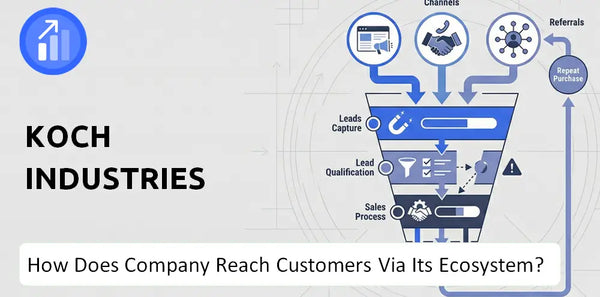
Koch Industries gains pull when partners can stock, move, and support its products fast. That gives the firm route-to-market leverage without needing consumer-style brand spend.
Who Does Koch Industries Sell To and Through Which Channels?
Koch Industries Company sells to industrial buyers, downstream manufacturers, distributors, retailers, contractors, farmers, and institutional customers. The main routes are direct business-to-business sales in chemicals, refining, energy, and polymers, plus indirect channels in pulp and paper, consumer products, and electronics-related lines.

Main route to market for Koch Industries Company
For Koch Industries Company, the main route to market is direct business account selling in industrial lines. That route shapes sales and demand because it links supply, pricing, and contract terms to large buyers.
- Main buyer group: industrial and commercial accounts
- Main channel: direct sales and contract supply
- Who controls access: procurement teams and technical buyers
- Why it matters: it drives repeat volume and margin
In refining, chemicals, energy, and polymers, Koch Industries Company reaches commodity counterparties and large account buyers through direct contracts, long-term supply talks, and trading desks. This is where brand trust matters most, because buyers care about continuity, spec quality, and delivery confidence more than broad consumer ads.
In pulp and paper, building products, and consumer lines, Koch Industries Company sells through wholesalers, retailers, building-supply channels, and institutional procurement teams. That mix makes customer loyalty and shelf access important, since channel partners can shape sales and demand through stocking, reorder speed, and end-buyer availability.
In electronics and software-linked businesses, OEMs, design engineers, and contract manufacturers are the key decision makers. The Demand Ecosystem of Koch Industries Company shows how this tighter, specification-led route links consumer trust, technical approval, and repeat orders to revenue.
How Koch Industries Company builds brand trust starts with reliability in B2B supply. In industrial markets, brand reputation often acts as a risk filter, so buyers prefer suppliers that can meet specs, keep uptime, and hold contract terms steady.
Koch Industries Company demand generation strategy varies by business, but the pattern is clear: direct accounts for heavy industry, channel partners for mass reach, and technical approval for engineered products. That is how trust affects demand for Koch Industries Company products and how industrial brands convert trust into demand.
One clear rule: where switching costs are high, trust buys time and volume.
Koch Industries SWOT Analysis
- Organized to Save Time on Analysis
- Fully Customizable
- Editable in Excel & Word
- Professional Formatting
- Investor-Ready Format

How Does Koch Industries Reach the Market Through Partners, Platforms, or Distribution?
Koch Industries Company reaches buyers through direct account teams, distributors, and hard-to-replace logistics assets. In industrial markets, brand trust and sales and demand depend less on ads and more on approved-supplier status, technical fit, and delivery access.
 Pipeline and logistics control drive the strongest market access
Koch Industries Company moves product through pipelines, terminals, rail, truck, barge, and storage networks, so physical access often decides who can buy and when. That structure shapes how Koch Industries Company maintains customer confidence and how trust affects demand for Koch Industries Company products. In capital-heavy markets, this is a core part of how industrial brands convert trust into demand. See the Ecosystem Growth Outlook of Koch Industries Company for related context.
Approved-supplier status is the main route-to-market dependency
For industrial customers, Koch Industries Company business growth drivers often include technical qualification, plant integration, and long-term supply contracts. In consumer and building-product channels, shelf placement, contractor preference, and customer loyalty matter more, which is why Koch Industries Company brand reputation management links directly to how Koch Industries Company turns reputation into revenue.
Across a workforce of about 120,000 in roughly 50 countries, Koch Industries Company uses partner routes and direct sales paths to reach segmented markets. That mix supports Koch Industries Company marketing and brand strategy, especially where brand trust and customer loyalty shape the relationship between brand trust and purchasing decisions.
Koch Industries Value Chain Analysis
- Structured to Support Better Decisions
- Effortlessly Communicate Your Business Strategy
- Investor-Ready Format
- 100% Editable and Customizable
- Clear and Structured Layout

How Does Koch Industries Convert Ecosystem Access Into Revenue?
Koch Industries Company converts ecosystem access into sales and demand by using trust to win repeat orders, long contracts, and fuller use of plants, terminals, and logistics networks. That raises volume share, margin spread, and delivery efficiency, so customers buy more often and rely on integrated service. See Ecosystem Principles of Koch Industries Company.
| Access Channel | How It Converts to Revenue | Why It Matters |
|---|---|---|
| Long-term customer contracts | Trusted service turns into repeat orders and steadier offtake, which supports higher plant runs and better pricing discipline. | It makes revenue less volatile and lifts asset use. |
| Integrated supply and logistics network | Control of storage, transport, and processing keeps more value in house and reduces handoff costs to intermediaries. | That widens margin spread and improves delivery reliability. |
| Bundled industrial offerings | Buyers that trust performance are more open to packaged supply, service, and delivery terms, which increases account value. | Bundling raises wallet share and supports customer loyalty. |
The most economically important route is integrated supply and logistics, because it links brand trust directly to cash conversion, margin spread, and throughput. In Koch Industries Company, this is the clearest way how brand trust drives sales for Koch Industries Company: trusted delivery cuts friction, protects volume, and keeps more value inside the chain. That is why how industrial brands convert trust into demand often comes down to who controls the network, not just who sells the product. Public 2025 reporting from large industrial peers shows logistics and processing gains can move operating income by hundreds of millions, which is why Koch Industries Company business growth drivers are tied so closely to asset use and customer confidence.
Koch Industries Business Model Canvas
- Clean, Modern, and Easy to Present
- No Research Needed – Save Hours of Work
- Built by Experts, Trusted by Consultants
- Instant Download, Ready to Use
- 100% Editable, Fully Customizable

What Shapes Koch Industries's Route-to-Market Outlook?
Koch Industries Company route-to-market outlook is shaped by commodity swings, regulation, and buyer pressure for lower-emissions supply chains. Its best access comes where reliability, scale, and technical service matter most; its weakest spots are price-fought, fast-switching segments and policy-sensitive lines. Brand trust helps sales and demand only when delivery, cost, and resilience stay strong.
Strongest access advantage: reliability in complex industrial markets
Koch Industries Company has its clearest route-to-market edge where buyers value uptime, logistics reach, and technical support. In those markets, Value Chain Role of Koch Industries Company matters because service consistency and scale can support customer loyalty and repeat purchasing.
This is how Koch Industries Company builds brand trust in industrial settings: it reduces supply risk, not just price friction.
Key future access risk: price pressure and policy exposure
The main threat to Koch Industries Company brand reputation management is heavy exposure to commodity-cycle volatility and changing regulation. In 2025, industrial buyers kept pushing harder on emissions, cost, and delivery terms, so weak pricing power can quickly cut sales and demand.
Where substitution is easy or policy risk is high, consumer trust and buyer confidence can shift fast, and how trust affects demand for Koch Industries Company products depends on proof of lower cost, lower emissions, and stable supply.
Koch Industries Company demand generation strategy will depend on proving operational resilience, keeping logistics optional, and matching customer expectations on sustainability and service. That is the core link between brand trust and sales and demand, and it shapes how industrial brands convert trust into demand when buyers compare total cost, risk, and delivery performance.
Koch Industries VRIO Analysis
- Designed for Fast Business Analysis
- Structured for Consultants, Students, and Founders
- 100% Editable in Microsoft Word & Excel
- Instant Digital Download – Use Immediately
- Compatible with Mac & PC – Fully Unlocked

Related Blogs
- Who Connects Most Strongly With the Brand of Koch Industries Company?
- How Strong Is Koch Industries Company’s Brand Position Against Competitors?
- How Could Ecosystem Shifts Change the Growth Outlook of Koch Industries Company?
- Who Owns Koch Industries Company and How Does Ownership Affect Trust in the Brand?
- What Do the Mission, Vision, and Values of Koch Industries Company Say About Its Brand Purpose?
- How Did Koch Industries Company Build the Brand It Has Today?
- How Does Koch Industries Company Work and Support Its Brand Promise?
Frequently Asked Questions
Brand trust lowers perceived supply risk for Koch Industries' buyers. Since 1940, Koch Industries has built trust around reliability, product consistency, and long-cycle relationships. That matters in industrial markets because customers often make 1- to 3-year purchasing decisions and prefer suppliers that reduce shutdown risk, delivery uncertainty, and qualification costs.
Disclaimer
All information, articles, and product details provided on this website are for general informational and educational purposes only. We do not claim any ownership over, nor do we intend to infringe upon, any trademarks, copyrights, logos, brand names, or other intellectual property mentioned or depicted on this site. Such intellectual property remains the property of its respective owners, and any references here are made solely for identification or informational purposes, without implying any affiliation, endorsement, or partnership.
We make no representations or warranties, express or implied, regarding the accuracy, completeness, or suitability of any content or products presented. Nothing on this website should be construed as legal, tax, investment, financial, medical, or other professional advice. In addition, no part of this site - including articles or product references - constitutes a solicitation, recommendation, endorsement, advertisement, or offer to buy or sell any securities, franchises, or other financial instruments, particularly in jurisdictions where such activity would be unlawful.
All content is of a general nature and may not address the specific circumstances of any individual or entity. It is not a substitute for professional advice or services. Any actions you take based on the information provided here are strictly at your own risk. You accept full responsibility for any decisions or outcomes arising from your use of this website and agree to release us from any liability in connection with your use of, or reliance upon, the content or products found herein.