
How does Séché Environnement reach buyers through its waste and compliance channel?
Séché Environnement sells through regulated industrial and public buyer networks, where permits and service reliability drive demand. In 2025, tighter circular-economy and traceability needs keep partner and contract access central. Seche Environnement Value Chain Analysis
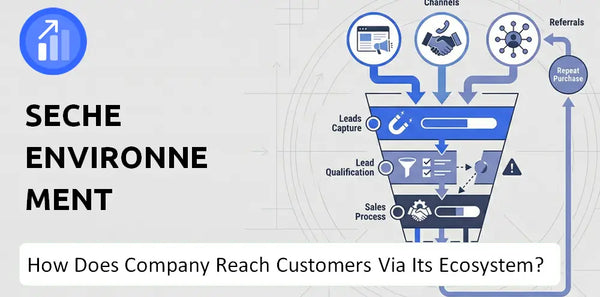
Its route to market works because clients need legal handling, not just disposal. That makes long contracts and site access more valuable than broad brand reach.
Who Does Seche Environnement Sell To and Through Which Channels?
Séché Environnement Company sells mainly to industrial firms, local authorities, and healthcare sites. Industrial clients matter most because they create recurring hazardous waste needs, while public buyers and hospitals rely on direct contracts, tenders, and framework deals that shape sales and demand.

Main route to market for Séché Environnement Company
The core route is direct B2B and public-sector selling. That is where brand trust turns into sales and demand, because buyers need proof of compliance, safety, and service continuity before they sign.
- Main buyer group: industrial companies
- Main channel: tenders and direct contracts
- Access controller: procurement and site teams
- Commercial value: repeat, regulated revenue
Industrial buyers are the most strategic for Séché Environnement Company because they often produce steady hazardous and specialty waste streams that need compliant handling. This is where brand trust, customer trust, and brand reputation matter most in how Seche Environnement Company builds brand trust and keeps it in the sales cycle.
Local authorities are another key buyer group because they anchor municipal collection, sorting, and treatment flows. Their access is usually controlled by public procurement rules, so the Seche Environnement Company marketing and sales strategy depends on winning tenders, meeting service terms, and proving operational reliability.
Healthcare facilities need secure routes for regulated waste, so the buying process is narrower and more controlled. In practice, how reputation affects sales in waste management is simple: if the buyer doubts traceability, compliance, or continuity, demand generation slows fast.
Sales are not driven by mass-market promotion. They come through account management, framework agreements, and site-specific service contracts, which is a key part of the Seche Environnement Company reputation and market demand story. For a wider view of the group's market position, see Ecosystem Growth Outlook of Seche Environnement Company
Seche Environnement SWOT Analysis
- Organized to Save Time on Analysis
- Fully Customizable
- Editable in Excel & Word
- Professional Formatting
- Investor-Ready Format

How Does Seche Environnement Reach the Market Through Partners, Platforms, or Distribution?
Séché Environnement Company reaches the market through permitted sites, collection fleets, transfer points, and long-term ties with industrial clients and public buyers. That network makes brand trust visible in daily service, and it turns compliance, local presence, and treatment capacity into sales and demand.
 Permitted sites drive the strongest market access
Séché Environnement Company sells access to infrastructure as much as it sells waste services. Its treatment sites, landfills, and energy-recovery assets make the company commercially visible to industrial generators that need compliant routes for hazardous and non-hazardous waste. That is a direct channel for how brand trust drives sales for Seche Environnement Company.
Local operating footprints shape the main route to market
The main dependency is physical access to waste streams, not digital platforms. The company depends on local collection, transfer, and treatment links, plus partnerships with energy off-takers, recyclers, and subcontractors. That structure supports client retention strategy, how reputation affects sales in waste management, and demand generation strategy for environmental services companies.
Access also depends on regulated relationships. Industrial site operators, transport providers, compliance authorities, and public buyers decide whether a route is usable, so customer trust and brand reputation matter at every step. This is why Seche Environnement Company market positioning is tied to permitting depth and operating reliability, not only price.
Local footprints shorten the path from waste creation to treatment, which helps how Seche Environnement Company attracts new customers and keeps existing ones. The company's ecosystem also depends on energy off-takers and specialist recyclers, and that broadens its reach into more waste streams and more contract types. See the wider market map in Ecosystem Competition of Seche Environnement Company.
The core route is simple: collection, transfer, treatment, and recovery. That chain supports ways Seche Environnement Company converts trust into revenue because buyers want one compliant path, one operator, and fewer handoffs. In industrial services, brand trust impact on sales is strongest when failure risk is high and switching costs are real.
Seche Environnement Value Chain Analysis
- Structured to Support Better Decisions
- Effortlessly Communicate Your Business Strategy
- Investor-Ready Format
- 100% Editable and Customizable
- Clear and Structured Layout

How Does Seche Environnement Convert Ecosystem Access Into Revenue?
Séché Environnement Company turns ecosystem access into sales and demand by sitting close to regulated waste flows and charging for each step it controls. Brand trust helps it win recurring contracts for collection, sorting, treatment, and disposal, while its service depth lets it capture more of each customer site and reduce switching.
| Access Channel | How It Converts to Revenue | Why It Matters |
|---|---|---|
| Collection and logistics access | Charges pickup, transport, and handling fees tied to volume and frequency. | It creates steady demand generation from daily operational needs. |
| Treatment and hazardous-waste access | Sells sorting, decontamination, and specialist treatment at premium rates. | Regulated streams raise customer trust and support stronger pricing power. |
| Disposal, energy, and recovery access | Earns landfill gate fees, energy-recovery income, and recovered-material sales. | It converts one waste stream into several revenue lines and supports retention. |
The most economically important route is the integrated one, because it captures more of the chain at once. That is the core of how brand trust drives sales for Seche Environnement Company: customers buy traceability, continuity, and risk transfer, then stay for multi-site contracts and bundled services. For a wider view, see Demand Ecosystem of Seche Environnement Company and how Seche Environnement Company converts trust into revenue.
Seche Environnement Business Model Canvas
- Clean, Modern, and Easy to Present
- No Research Needed – Save Hours of Work
- Built by Experts, Trusted by Consultants
- Instant Download, Ready to Use
- 100% Editable, Fully Customizable

What Shapes Seche Environnement's Route-to-Market Outlook?
Seche Environnement Company's route-to-market outlook is helped by tighter environmental rules, more demand for traceable waste treatment, and circular-economy needs. It is hurt by permit scarcity, high capex, energy-price swings, and cyclical industrial volumes, so brand trust, customer trust, and reliable execution stay central to sales and demand.
Strongest access advantage: compliant capacity and trust
Seche Environnement Company can win buyers where handling risk is high and service failures are costly. That supports how Seche Environnement Company builds brand trust, because industrial clients usually stay with operators that prove safety, traceability, and uptime.
Its Industry History of Seche Environnement Company shows why reputation matters in waste management and why that can lift sales and demand over time.
Key future access risk: permits, capex, and volatile volumes
Future route-to-market strength can weaken if new capacity is slow to permit or too costly to build. Heavy capex, energy-price volatility, and uneven industrial output can also pressure margins and slow demand generation.
In public procurement, price competition can still override brand reputation, so Seche Environnement Company client retention strategy must keep proving value on compliance, service quality, and uptime.
Seche Environnement VRIO Analysis
- Designed for Fast Business Analysis
- Structured for Consultants, Students, and Founders
- 100% Editable in Microsoft Word & Excel
- Instant Digital Download – Use Immediately
- Compatible with Mac & PC – Fully Unlocked

Related Blogs
- Who Connects Most Strongly With the Brand of Seche Environnement Company?
- How Strong Is Seche Environnement Company’s Brand Position Against Competitors?
- How Could Ecosystem Shifts Change the Growth Outlook of Seche Environnement Company?
- Who Owns Seche Environnement Company and How Does Ownership Affect Trust in the Brand?
- What Do the Mission, Vision, and Values of Seche Environnement Company Say About Its Brand Purpose?
- How Did Seche Environnement Company Build the Brand It Has Today?
- How Does Seche Environnement Company Work and Support Its Brand Promise?
Frequently Asked Questions
Séché Environnement converts trust into sales by proving regulated handling, traceability, and 24/7 service continuity across 3 core customer groups. In waste services, buyers pay for risk reduction, not just disposal. That supports multi-year contracts, protects pricing on hazardous streams, and helps the company win more volume when customers want one compliant partner across multiple sites.
Disclaimer
All information, articles, and product details provided on this website are for general informational and educational purposes only. We do not claim any ownership over, nor do we intend to infringe upon, any trademarks, copyrights, logos, brand names, or other intellectual property mentioned or depicted on this site. Such intellectual property remains the property of its respective owners, and any references here are made solely for identification or informational purposes, without implying any affiliation, endorsement, or partnership.
We make no representations or warranties, express or implied, regarding the accuracy, completeness, or suitability of any content or products presented. Nothing on this website should be construed as legal, tax, investment, financial, medical, or other professional advice. In addition, no part of this site - including articles or product references - constitutes a solicitation, recommendation, endorsement, advertisement, or offer to buy or sell any securities, franchises, or other financial instruments, particularly in jurisdictions where such activity would be unlawful.
All content is of a general nature and may not address the specific circumstances of any individual or entity. It is not a substitute for professional advice or services. Any actions you take based on the information provided here are strictly at your own risk. You accept full responsibility for any decisions or outcomes arising from your use of this website and agree to release us from any liability in connection with your use of, or reliance upon, the content or products found herein.