
How strong is Group 1 Automotive against the players that control auto retail?
Group 1 Automotive competes in a system shaped by OEM supply, lender terms, and digital lead flow. In 2025, those channels still decide who gets traffic, margins, and service repeat business. That makes brand strength more than awareness.
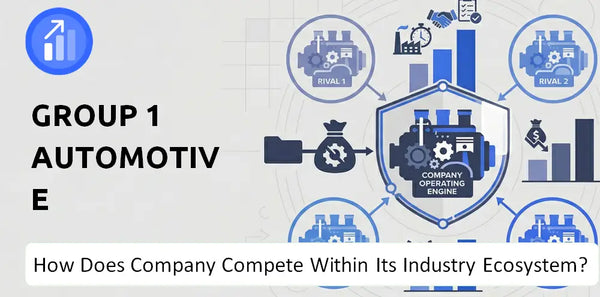
Its real power shows up in local trust, fixed ops, and financing access, not just showroom name recall. See Group 1 Automotive Value Chain Analysis for the control points that matter.
Where Does Group 1 Automotive Stand in the Ecosystem?
Group 1 Automotive sits in the middle of the auto value chain: it depends on OEMs for inventory and franchise rights, but it reaches consumers through local stores, service bays, and finance desks. That makes the Group 1 Automotive market position durable, yet still constrained by brand rules, online price comparison, and lender and insurer power.

Group 1 Automotive's Structural Position in Auto Retail
Group 1 Automotive is a franchised retailer, not an upstream brand owner, so its control is strongest at the point of sale and aftersale service. Its Route to Market of Group 1 Automotive Company rests on a local store model, with recurring revenue from parts, maintenance, and collision work.
In 2025, the business remains tied to OEM allocation, incentive programs, and consumer pricing transparency. That leaves structural power split between the Group 1 Automotive brand, the manufacturer, and digital marketplaces.
- Current role: franchised auto retail and service
- Structural power: OEMs and digital channels
- Protection level: recurring aftersale revenue
- Competitive impact: limits brand pricing power
- Market signal: service depth supports loyalty
On scale, Group 1 Automotive remains a large player in automotive retail competition, with 2024 revenue of about 19.9 billion dollars and operations in both the US and UK. That scale helps the Group 1 Automotive dealership network compete on inventory access, service throughput, and finance penetration, but it does not create the kind of standalone brand power seen in a luxury auto dealership brand at the OEM level.
The hard edge in the Group 1 Automotive competitive advantage in automotive retail is the post-sale loop. Service departments, parts counters, and collision centers create repeat traffic, which helps defend the Group 1 Automotive dealership reputation even when new-car margins get squeezed by incentives and online pricing.
Against Group 1 Automotive competitors such as large public dealer groups, the real test is not just store count. It is whether the Group 1 Automotive customer experience compared with rivals can keep buyers and service customers inside the ecosystem after the first sale, especially in premium and luxury channels where trust, convenience, and response time matter most.
The biggest constraint on Group 1 Automotive market share versus competitors is that much of the value chain sits elsewhere. OEMs control product, lenders control affordability, insurers influence repair flow, and marketplaces shape price discovery, so the Group 1 Automotive brand awareness in the auto retail industry matters less than execution at the store level.
Group 1 Automotive SWOT Analysis
- Organized to Save Time on Analysis
- Fully Customizable
- Editable in Excel & Word
- Professional Formatting
- Investor-Ready Format

Who Competes With Group 1 Automotive for Power in the Same System?
Group 1 Automotive competes in a system shaped by large dealer groups, OEMs, digital marketplaces, lenders, and insurers. The biggest pressure comes from rivals that control traffic, pricing, and repeat service, not just showroom sales.
 AutoNation sets the clearest scale challenge
AutoNation is one of the strongest Group 1 Automotive competitors in US retail because it competes on size, inventory reach, and service capture across many metro markets. In 2024, AutoNation reported more than 300 franchise and used-vehicle locations, which gives it broad customer touchpoints and stronger local recall.
For a Group 1 Automotive brand comparison, the fight is not only for sales. It is also for service visits, trade-ins, finance profit, and repeat buyers, which shape lifetime customer value. The Value Chain Role of Group 1 Automotive Company matters here because service and used cars often matter as much as new-car floor traffic.
Digital retail and OEM channels are the key substitute system
CarMax, Carvana, OEM websites, and marketplace sites compete for the first click and the final deal. That makes them a direct substitute system for the Group 1 Automotive dealership network, especially when shoppers compare payment, inventory, and delivery speed before visiting a store.
OEMs such as Toyota, Ford, General Motors, BMW, and Mercedes-Benz still control product allocation, certified programs, and brand halo, so they hold structural power over the Group 1 Automotive market position. Lenders and insurers add another gate: if credit terms tighten or insurance costs rise, conversion drops even when demand stays steady.
In the UK, Vertu Motors, Lookers, Arnold Clark, and Inchcape compete in the same dealer power structure, but local brand strength still depends on OEM approval and aftersales trust. That means Group 1 Automotive competitive advantage in automotive retail is built less on pure advertising and more on store execution, premium brand positioning, and customer retention.
Group 1 Automotive Value Chain Analysis
- Structured to Support Better Decisions
- Effortlessly Communicate Your Business Strategy
- Investor-Ready Format
- 100% Editable and Customizable
- Clear and Structured Layout

What Gives Group 1 Automotive an Ecosystem Advantage?
Group 1 Automotive brand advantage comes from owning the full sale-to-service chain. The Group 1 Automotive dealership network connects OEM inventory, finance and insurance, used cars, and fixed ops, so the firm earns from more than one step of the customer journey and stays embedded with buyers after the first transaction.
| Structural Advantage | How It Helps the Company | Why It Matters |
|---|---|---|
| Franchised OEM access | Gives direct access to new-vehicle inventory, factory programs, and brand traffic. | This supports the Group 1 Automotive market position because it ties demand to manufacturer supply and showroom traffic. |
| Post-sale monetization | Used cars, financing and insurance, service, parts, and collision expand revenue after the sale. | This makes the Group 1 Automotive competitive advantage in automotive retail stronger than a pure lead generator or a single-point retailer. |
| US and UK diversification | Spreads exposure across two markets, incentive cycles, and OEM relationships. | This lowers dependence on one cycle and helps the Ecosystem Growth Outlook of Group 1 Automotive Company stay resilient through shifts in automotive retail competition. |
The strongest structural advantage looks like the post-sale stack, especially service, parts, and collision. That is where the Group 1 Automotive dealership reputation becomes sticky, because customers return after the first purchase, which supports the Group 1 Automotive customer experience compared with rivals and makes the Group 1 Automotive brand harder to replace than a one-time sales funnel. In a Group 1 Automotive vs AutoNation brand comparison, this kind of embeddedness often matters more than raw awareness in the auto retail industry.
Group 1 Automotive Business Model Canvas
- Clean, Modern, and Easy to Present
- No Research Needed – Save Hours of Work
- Built by Experts, Trusted by Consultants
- Instant Download, Ready to Use
- 100% Editable, Fully Customizable

What Does the Competitive Outlook Say About Group 1 Automotive's Position?
In the 2025-2026 market, Group 1 Automotive is more likely to defend and slowly strengthen its Group 1 Automotive market position than to win broad consumer mindshare. The Group 1 Automotive brand should stay structurally relevant through execution, service retention, and omnichannel retailing, while OEM brands and digital platforms keep most of the attention.
Service retention and execution support durability
The clearest support for Group 1 Automotive competitive advantage in automotive retail is the service lane. A stronger service mix can lift repeat traffic, help retention, and make the Group 1 Automotive dealership network more important even when new-car demand shifts.
That matters because Group 1 Automotive dealership reputation is built less on fame and more on day-to-day delivery. In a market where how strong is Group 1 Automotive brand position against competitors depends on response speed, pricing, and inventory clarity, good execution keeps the business relevant.
Digital transparency and rate pressure limit brand power
The biggest pressure on Group 1 Automotive competitors is that shoppers can compare prices fast, and financing costs still shape purchase decisions. That weakens pure brand recall and keeps Group 1 Automotive customer experience compared with rivals tied to convenience, trust, and price discipline.
This means the Group 1 Automotive brand will face ongoing automotive retail competition from OEM-led marketing and large digital platforms. Even with a solid luxury auto dealership brand strategy, Group 1 Automotive brand awareness in the auto retail industry is unlikely to overtake the OEMs that own the primary mindshare.
Group 1 Automotive VRIO Analysis
- Designed for Fast Business Analysis
- Structured for Consultants, Students, and Founders
- 100% Editable in Microsoft Word & Excel
- Instant Digital Download – Use Immediately
- Compatible with Mac & PC – Fully Unlocked

Related Blogs
- Who Connects Most Strongly With the Brand of Group 1 Automotive Company?
- How Could Ecosystem Shifts Change the Growth Outlook of Group 1 Automotive Company?
- Who Owns Group 1 Automotive Company and How Does Ownership Affect Trust in the Brand?
- What Do the Mission, Vision, and Values of Group 1 Automotive Company Say About Its Brand Purpose?
- How Did Group 1 Automotive Company Build the Brand It Has Today?
- How Does Group 1 Automotive Company Turn Brand Trust Into Sales and Demand?
- How Does Group 1 Automotive Company Work and Support Its Brand Promise?
Frequently Asked Questions
Group 1 Automotive's brand is solid but not dominant. It is stronger as a Fortune 300 operator than as a household consumer name, and its 2-country footprint across the US and UK helps credibility. The brand matters most after the sale, where 5 revenue pools-vehicles, F&I, service, parts, and collision-create repeat traffic and loyalty.
Disclaimer
All information, articles, and product details provided on this website are for general informational and educational purposes only. We do not claim any ownership over, nor do we intend to infringe upon, any trademarks, copyrights, logos, brand names, or other intellectual property mentioned or depicted on this site. Such intellectual property remains the property of its respective owners, and any references here are made solely for identification or informational purposes, without implying any affiliation, endorsement, or partnership.
We make no representations or warranties, express or implied, regarding the accuracy, completeness, or suitability of any content or products presented. Nothing on this website should be construed as legal, tax, investment, financial, medical, or other professional advice. In addition, no part of this site - including articles or product references - constitutes a solicitation, recommendation, endorsement, advertisement, or offer to buy or sell any securities, franchises, or other financial instruments, particularly in jurisdictions where such activity would be unlawful.
All content is of a general nature and may not address the specific circumstances of any individual or entity. It is not a substitute for professional advice or services. Any actions you take based on the information provided here are strictly at your own risk. You accept full responsibility for any decisions or outcomes arising from your use of this website and agree to release us from any liability in connection with your use of, or reliance upon, the content or products found herein.